
At the Good Science Project, we have often written about the need for institutional diversity in science, as opposed to the current institutional isomorphism (where most organizations look and operate the same way). As I said in an interview published yesterday:
When all institutions look the same, their output tends to be the same as well. Tens of thousands of scientists (usually government-funded) labor within the same constraints, incentives, and pressures to conform.
If we want to see a higher rate of scientific breakthroughs, we should pursue institutional diversity for that reason alone. Breakthroughs are by definition a break with the status quo in some respect — and if the status quo is too uniform and powerful everywhere, it would be hard for any individual scientist to contradict the entire ecosystem that provides his or her entire livelihood and professional reputation.
Institutional diversity may be one of the key ways to produce ideological diversity in science — that is, scientists who are empowered to take a different view precisely because they have a different position and source of salary, rather than being forever hobbled by those constraints.
With all of that in mind, these are exciting times.
First, just today, the National Science Foundation’s Technology, Innovation and Partnerships directorate at long last announced its Tech Labs initiative, which is intended to provide $10-$50 million a year to independent research teams (and yes, that is a per team dollar amount, not the initiative’s entire budget).
The intent is to provide “entrepreneurial teams of proven scientists the freedom and flexibility to pursue breakthrough science at breakneck speed, without needing to frequently stop and apply for additional grant funding with each new idea or development.”
The idea has many precursors, including all of the independent research labs and organizations going back several decades, the recent burst of philanthropy for new institutes and organizations, the idea of focused research organizations (here’s a good piece from today), Caleb Watney’s excellent piece proposing X-Labs, and Jeffrey Tsao’s proposal for Bell Labs X.
But this is the first time the federal government has gotten into the business of actively pushing for institutional diversity and for scientific funding at the team level.
Huge, if it works.
And there is reason to think it might work. Rather than relying on the often-invoked Bell Labs and Xerox PARC, let’s look at other organizations — symphony orchestras and professional sports teams.
The New York Philharmonic doesn’t make its principal viola player spend all of her time trying to find individual grants to support her salary while writing up extensive reports on how much she practiced every month and an analysis of her part in each performance. Instead, the orchestra raises money for the institution from donations, ticket sales, and album sales. The institution is then responsible for selecting the best performers and enabling them to do their best work as a team.
Similarly, the Golden State Warriors don’t make Steph Curry spend all his time writing up 50-page proposals for each $1 million chunk of his salary, along with regular written reports on his performance in each of the 82 games per season. Instead, they let him focus on practicing and playing basketball. Indeed, they even hire a shooting coach to develop unique drills so that Curry, already the best shooter in world history, can continue to get even better.
High-performing institutions usually work together as a whole, rather than making their individual employees spend so much time hustling for money. We should probably be doing more of this in science. In fact, I can imagine making a case for block funding to many universities and academic hospitals, which are (and will remain) an important cornerstone of scientific research.
Also worth noting: the press release says the funding is for “research teams outside of traditional academic institutions,” but there’s a bit of nuance to that. If you read the full PDF linked on this page, the teams that are eligible include “teams from within academia or industry that are ready to scale a technology or vision beyond their existing institutional structure(s).”
As well, I’m happy that NSF decided to include this as one of the 5 strategic priorities for each Tech Lab:

This is reminiscent of Jeff Tsao’s point that if we want to have a modern version of Bell Labs, we need to recreate a couple of conditions that made Bell Labs possible: (1) Alignment with a major industry focused on the frontier of applied R&D problems, but (2) the intellectual freedom to pursue curiosity-driven research and to pivot towards surprising findings.
Tsao argues that in today’s market, the intellectual freedom in (2) will arise only if government/philanthropy supports a research organization, while to attain (1), the organization needs to be deeply embedded with a major corporation that regularly surfaces cutting-edge problems that actually matter to the real world. Thus, we need public/private partnerships here. [NSF’s team was well aware of Tsao’s ideas.]
Finally, as I told the NSF team a few weeks ago, we need to consider the following question: “What is the optimal rate of failure that we’re looking for?” That is, given the desire to pursue “ambitious goals,” if all of the grantees come back a year or two later and say, “We succeeded in hitting 100% of our milestones!,” then someone wasn’t ambitious enough.
Nothing is guaranteed in life, and certainly not in science. If a scientific portfolio has a 100% success rate, then it is probably so incremental and obvious as to be worthless.
But what’s the optimal failure rate? (That is, failure not for reasons of incompetence or mismanagement, but because the scientific question can’t be solved quite yet.)
Well, that depends. The optimal failure rate has to be determined by anyone running a scientific funding program in advance—does your program want a 10% failure rate, 50%, 90%, or what? That expectation directly changes the amount of actual risk that a program will undertake.
Even at DARPA, it can be difficult to acknowledge failure (as Adam Russell has pointed out). Whether at NSF or anywhere else, anyone who wants to do/fund ambitious science has to get more comfortable with publicly acknowledging what didn’t work. Discussing failure has to be more normalized.
Anyway, NSF is asking for public comments to be submitted by Jan. 20, 2026. Send in your thoughts!
***
Second, just yesterday, the UK government signed an agreement with Google’s DeepMind (inventor of AlphaFold). As per DeepMind’s post, the initiative will: 1) modernize government by creating new AI tools for public servants, 2) develop new programs to improve education, and most significantly for our purposes, 3) “establish Google DeepMind’s first automated laboratory in the UK in 2026, specifically focused on materials science research.”
The rationale:
By directing world-class robotics to synthesize and characterize hundreds of materials per day, the team intends to significantly shorten the timeline for identifying transformative new materials.
Discovering new materials is one of the most important pursuits in science, offering the potential to reduce costs and enable entirely new technologies. For example, superconductors that operate at ambient temperature and pressure could allow for low cost medical imaging and reduce power loss in electrical grids. Other novel materials could help us tackle critical energy challenges by unlocking advanced batteries, next-generation solar cells and more efficient computer chips.
As with the NSF initiative, it is good to see a government agency partnering with a fairly new scientific organization to give funding at the institutional level to pursue ambitious goals. And given DeepMind’s track record thus far, I expect great things.
***
Third, Eric Gilliam (currently with Renaissance Philanthropy, while remaining a Good Science Project fellow) has been doing exciting work extending the ideas he developed over the past few years about creating new organizations along the lines of BBN (the ARPA contractor that actually developed the first version of the Internet).
Thanks to Renaissance Philanthropy’s engagement with the British agency ARIA, Eric’s work led to the Dec. 1 announcement of what they’re calling the Frontier Research Contractor Launchpad.
The goal is to build “a new class of ambitious, applied R&D organisations in the UK,” and a list of the initial organizations can be found here.
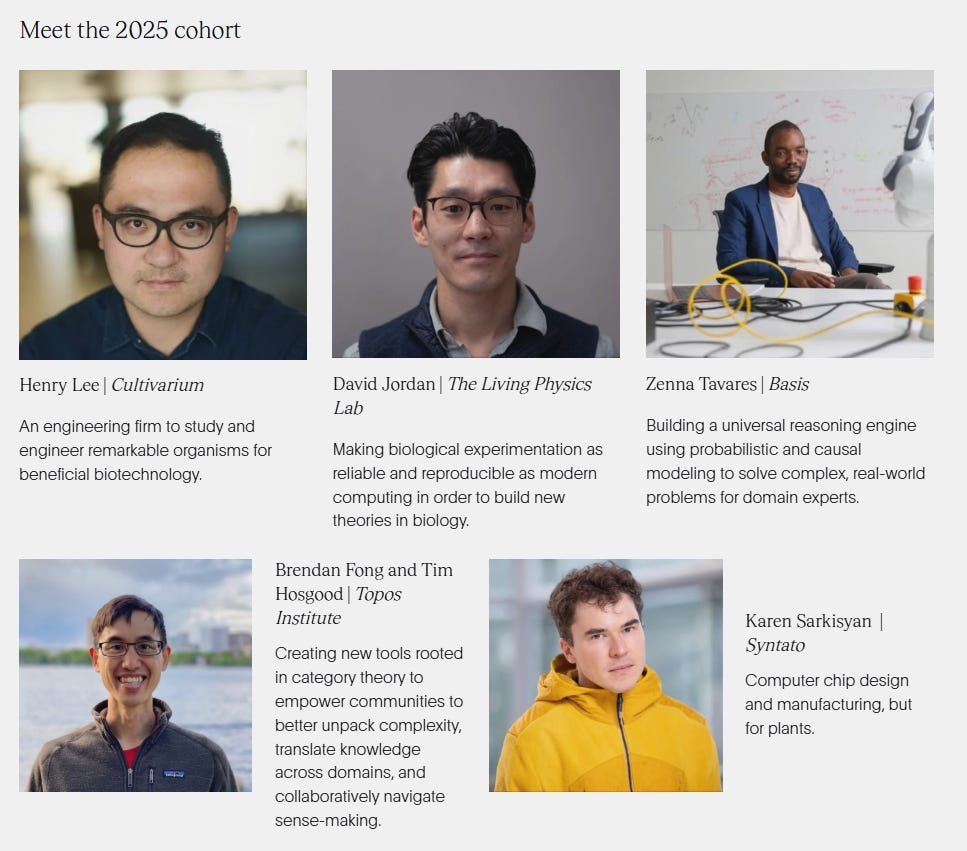
Eric has a bigger idea to fund more such organizations across the ecosystem, so get in touch if you’re interested.
***
PS: I used em-dashes several times above, as I usually do (and have done for many years). Just realized that given the recent trend of people claiming to identify AI-assisted writing, it might be worth clarifying: Everything above was written solely by me in the past 3 hours, and I use em-dashes because I grew up reading great writers who used them all the time: Dickens, Austen, Dostoevsky, Louisa May Alcott, Mark Twain, Herman Melville, etc. It is ironic that just because AI models were evidently trained on classic writers, people who aren’t well-read seem to think that AI models invented the em-dash! I will never stop using em-dashes.